Retail Vulnerability Management: 5 Practices of Teams That Respond Faster
by James Gordon, Lead Brinqa Expert//
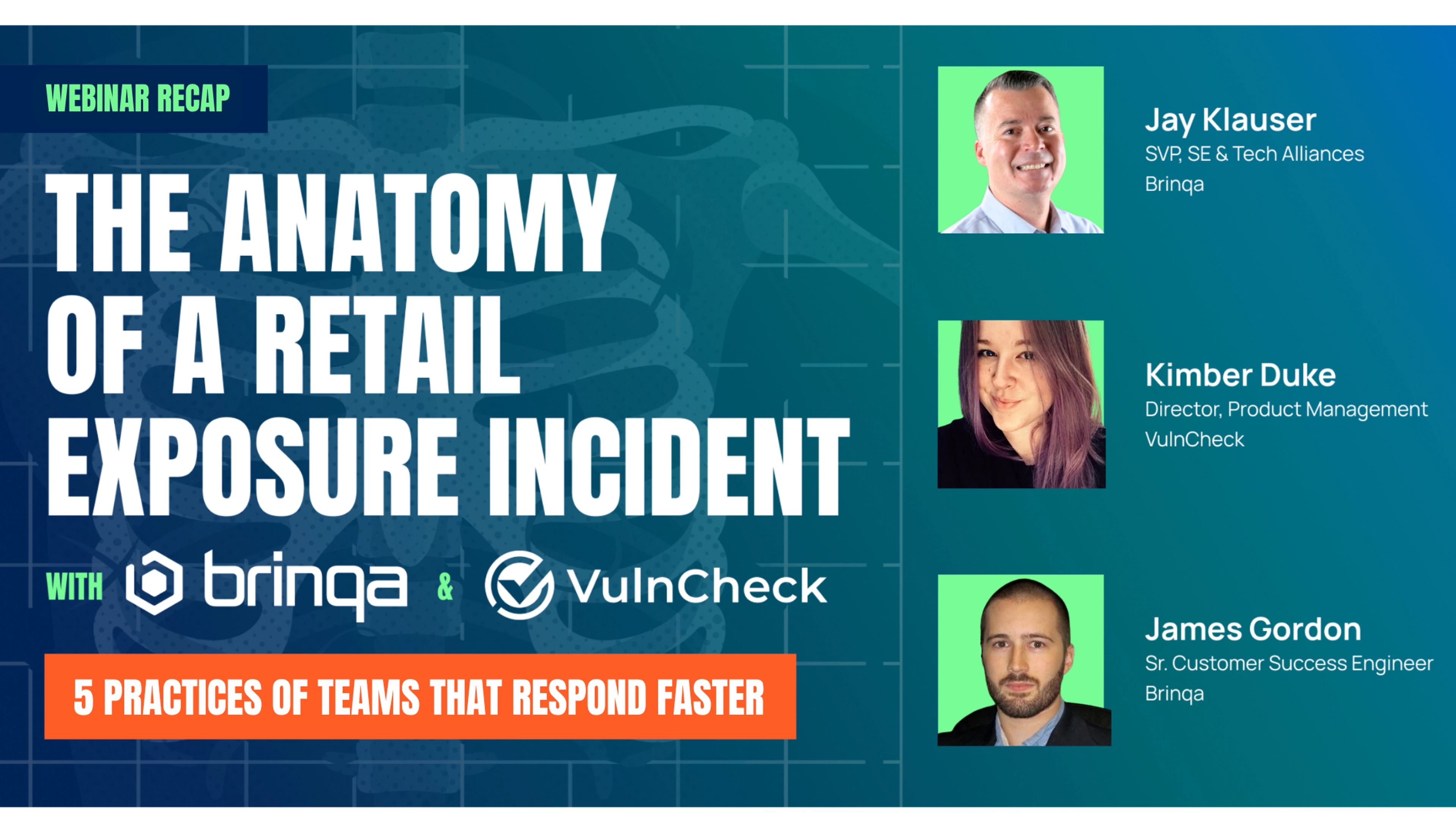
Based on insights from Brinqa's webinar: The Anatomy of a Retail Exposure Incident.
Retail is one of the most challenging verticals in vulnerability management — and one of the most targeted. According to the 2024 Verizon Data Breach Investigations Report, Magecart attacks and system intrusion dominate retail breach patterns, with credentials (38%) and payment card data (25%) the most frequently compromised. The attack surface spans hundreds of store locations, e-commerce platforms, payment processors, and legacy POS infrastructure — all at once.
What separates the teams that manage this well isn't better tooling or bigger budgets. It's how they've structured their programs to move from vulnerability signal to remediation action faster than their peers.
Vulnerability prioritization is the practice of determining which vulnerabilities represent the greatest real-world risk to a specific environment — and acting on them first. It goes beyond static severity scores to incorporate exploit intelligence, asset criticality, and business context. For retail security teams, effective prioritization is the bridge between legacy vulnerability management and the continuous, risk-based approach to exposure that high-performing programs are building toward. That shift from managing vulnerabilities to managing exposures continuously is what continuous threat exposure management (CTEM) formalizes as a program framework, and what distinguishes platforms built for it from those that bolt prioritization onto a scanning workflow.
Here are five practices that distinguish high-performing retail security teams, drawn from real incidents and real programs.
1. They build their patch strategy around operational constraints — not calendar cycles.
The teams that stay ahead know exactly when they can and can't patch. They design around that reality instead of fighting it.
Black Friday, Cyber Monday, the holiday season… for retail security teams, these aren't just high-traffic periods. They're maintenance blackouts. The teams that handle this well don't treat patching as a uniform monthly cycle. They've mapped their actual maintenance windows by environment: which stores can take downtime and when, which e-commerce components require failover before a patch can be applied, which POS systems need a physical technician on-site.
One practitioner described how the only viable window to upgrade core network infrastructure at a nationwide chain was Christmas Day — the one day of the year traffic was low enough to accept the risk. That level of planning precision is what enables fast response when a critical CVE drops outside the ideal window: the team already knows what's possible, and what the compensating controls are if patching isn't.
The practice: Maintain a patching capacity map alongside your asset inventory — broken down by environment type, location, and seasonal constraints. For assets that can't be patched on a standard cycle, pre-define the compensating controls. When a CVE drops, you're not figuring out your options under pressure.
The Brinqa Solution: See how security teams map patching capacity and automate remediation routing around real operational constraints.
2. They treat CVSS scores as a starting point, not a prioritization answer.
The teams responding fastest to real threats aren't chasing the highest scores. They're tracking which vulnerabilities are actually being weaponized.
The GoAnywhere managed file transfer vulnerability had a base CVSS score of 7.2 — rated "high," but not critical. Many organizations deprioritized it accordingly. It ended up impacting more than 130 organizations, with the Clop ransomware group among the actors exploiting it.
High-performing teams caught this early because they were tracking signals beyond the score:
- Proof-of-concept exploits appearing on GitHub within days of disclosure
- Active adoption into botnet toolkits
- Weaponization for ransomware deployment
- CISA KEV addition — treated as a confirmation, not the first alert
According to Mandiant research, the average time-to-exploit dropped to five days in 2023, down from 32 days just two years prior. VulnCheck data shows nearly one in four KEV-listed CVEs in 2024 were exploited on or before the day of public disclosure. Waiting for a score to tell you something is critical is waiting too long.
The practice: Build a prioritization model that layers threat intelligence signals on top of CVSS: known exploit availability, PoC maturity, KEV status, botnet adoption, ransomware usage. A 7.2 with a weaponized exploit in active circulation should jump ahead of a 9.8 with no exploitation activity.
The Brinqa + VulnCheck solution: See how exploit intelligence signals move the right vulnerabilities to the top of your queue — before ransomware groups do.
3. They assume exploitation starts in hours — and their response process is built accordingly.
CosmicSting saw scanning begin within five minutes of the advisory. The teams that weren't impacted had their playbooks ready before the CVE dropped.
CosmicSting (CVE-2024-2961), the critical Adobe Commerce and Magento vulnerability, saw active scanning begin within five minutes of the advisory being published. More than 4,000 e-commerce sites were ultimately impacted — roughly 5% of all Adobe Commerce customers.
The organizations that limited their exposure had one thing in common: a pre-built response process for high-risk platforms. They knew which assets were running Adobe Commerce, who owned them, and what the immediate mitigation steps were. When the advisory hit, they were executing — not assembling.
Retail's structural patching constraints make this especially important. The exposure window — the time between disclosure and remediation — is wider in retail than in most industries. The only way to compress it is to front-load as much of the response process as possible.
The practice: For every widely-deployed platform in your environment — e-commerce, managed file transfer, payment processing — maintain a pre-built response playbook: affected asset list, owner contacts, mitigation steps, and escalation path. Treat it as a living document, reviewed after each major CVE event.
The Brinqa Solution: See how retail security teams use exploit intelligence to cut response time from days to hours.
4. They've mapped asset ownership before they need it.
Fast response isn't just about knowing you're vulnerable. It's about knowing immediately who has to act — and making sure that person gets the right information automatically.
In large retail organizations, vulnerability ownership is rarely clean. A CVE affecting a POS vendor's software might sit at the intersection of store operations, central IT, a third-party managed services provider, and the vendor itself. Each handoff that has to be figured out under pressure adds hours to your response time.
The retail teams that responded fastest to CosmicSting weren't necessarily the ones with the most sophisticated scanning. They were the ones who had pre-mapped ownership and could route remediation assignments automatically when the advisory dropped. They'd also tied business context to their asset data: Is this system actually processing payments? Is it PCI-scoped? Is it internet-facing? That context determines whether a vulnerability on a given asset is a critical priority or a lower-urgency fix.
The practice: Connect each asset in your inventory to a responsible owner, its business function, network exposure profile, and payment-processing status. If a new CVE can't automatically route a remediation ticket to the right person the moment it's ingested, close that gap before the next incident.
The Brinqa solution: See how teams connect asset context to automatic remediation routing — so the right owner gets the right ticket the moment a CVE lands.
5. When a zero-day hits, they investigate backward — not just forward.
Patching closes the vulnerability. Retroactive investigation answers the harder question: was an attacker already inside before we knew?
The GoAnywhere zero-day was being exploited before it was publicly disclosed. That created a two-part problem for affected organizations: remediate the vulnerability, and determine whether they'd already been breached during the window when no one knew it existed.
The teams that handled it well had both capabilities ready. They applied mitigations quickly — and simultaneously ran a structured investigation to determine whether the pre-disclosure window had been exploited. They had pre-defined indicators of compromise to look for, forensic runbooks for the relevant system type, and clear criteria for when to escalate to incident response.
In a retail environment — where a compromised file transfer system or admin interface can have direct pathways to cardholder data — the retroactive question isn't optional. It's part of the response.
The practice: For every high-severity CVE response, especially zero-days, include a formal backward-looking investigation alongside your patching workflow. Define your "were we compromised?" criteria per system type before an incident. The answer to that question determines whether you're closing a vulnerability or responding to a breach.
The Brinqa solution: See how teams use historical exposure data to answer the backward-looking question after a zero-day.
What these five practices have in common
None of them require more resources. All of them require more structure — built before a CVE drops, not in response to one.
The retail organizations that handle vulnerability and exposure management well have invested in the infrastructure of response: ownership is mapped, business context is tied to asset data, threat intelligence feeds prioritization automatically, and response playbooks exist for the platforms most likely to be targeted. When a critical CVE hits, they're executing a process. Everyone else is building one.
The shift from reactive vulnerability response to a continuous, risk-contextualized exposure program is what Brinqa is built to support. If your team is managing any of this manually today, the webinar below shows what it looks like when it runs on a platform built for it.
Watch the Full Webinar
The Anatomy of a Retail Exposure Incident goes deeper on every practice covered here — including real incident walkthroughs of CosmicSting and GoAnywhere, and a live discussion of how retail security teams are building programs that can respond at the speed of modern exploitation.
Featuring:
- Kimber Duke, Director of Product, VulnCheck
- James Gordon, Team Lead, Brinqa Experts
- Jay Klauser, Solutions Engineering & Tech Alliances, Brinqa
FAQs
Retail faces a combination of challenges most industries don't share simultaneously: a broad physical attack surface spanning brick-and-mortar stores and e-commerce, payment card data as a high-value target, legacy POS systems that are difficult to patch on a standard cycle, and seasonal blackout periods that eliminate maintenance windows for significant parts of the year. The result is a wider-than-average exposure window and a more operationally complex remediation environment.
CVSS scores measure a vulnerability's theoretical characteristics in isolation — attack complexity, privileges required, scope of impact. They don't reflect whether a working exploit exists, whether it's actively used by ransomware groups, or whether it's been added to CISA's Known Exploited Vulnerabilities catalog. Effective vulnerability prioritization requires layering real-world threat intelligence signals on top of base scores.
Faster than most organizations can respond. Mandiant research shows the average time-to-exploit dropped to five days in 2023, down from 32 days two years prior. VulnCheck data from 2024 shows nearly one in four KEV-listed CVEs were exploited on or before the day of disclosure. For widely deployed platforms, assume exploitation attempts will begin within hours of an advisory going public.
Asset ownership mapping is the process of connecting each asset in your environment to a specific accountable team or individual responsible for its security and maintenance. In retail, where assets span hundreds of locations, multiple vendors, and different technical environments, ownership is rarely obvious from an inventory alone. Without pre-mapped ownership, remediation tickets go to the wrong team, delays compound, and the exposure window grows.
Two things simultaneously: apply available mitigations as quickly as the operational environment allows, and assess whether the organization was compromised before the vulnerability was publicly known. Zero-days are exploited before patches exist — the patch may close the door after the attacker has already entered. Effective zero-day response requires pre-positioned detection capability and a defined process for determining whether a breach occurred during the pre-disclosure window.
Retail patch management is constrained by operational factors most sectors don't face at the same scale. Seasonal high-traffic periods eliminate maintenance windows for large portions of the year. Distributed store networks require physical access for on-site upgrades. E-commerce platforms require failover infrastructure and planned payment downtime. Many retail POS systems still run legacy operating systems outside standard patch cycles — creating a structural gap between patching capacity and the speed of modern exploitation.