Fourteen Hundred CVEs, One Fire: The Count Has Stopped Telling You Anything.
by Ron Dovich, CAIO//
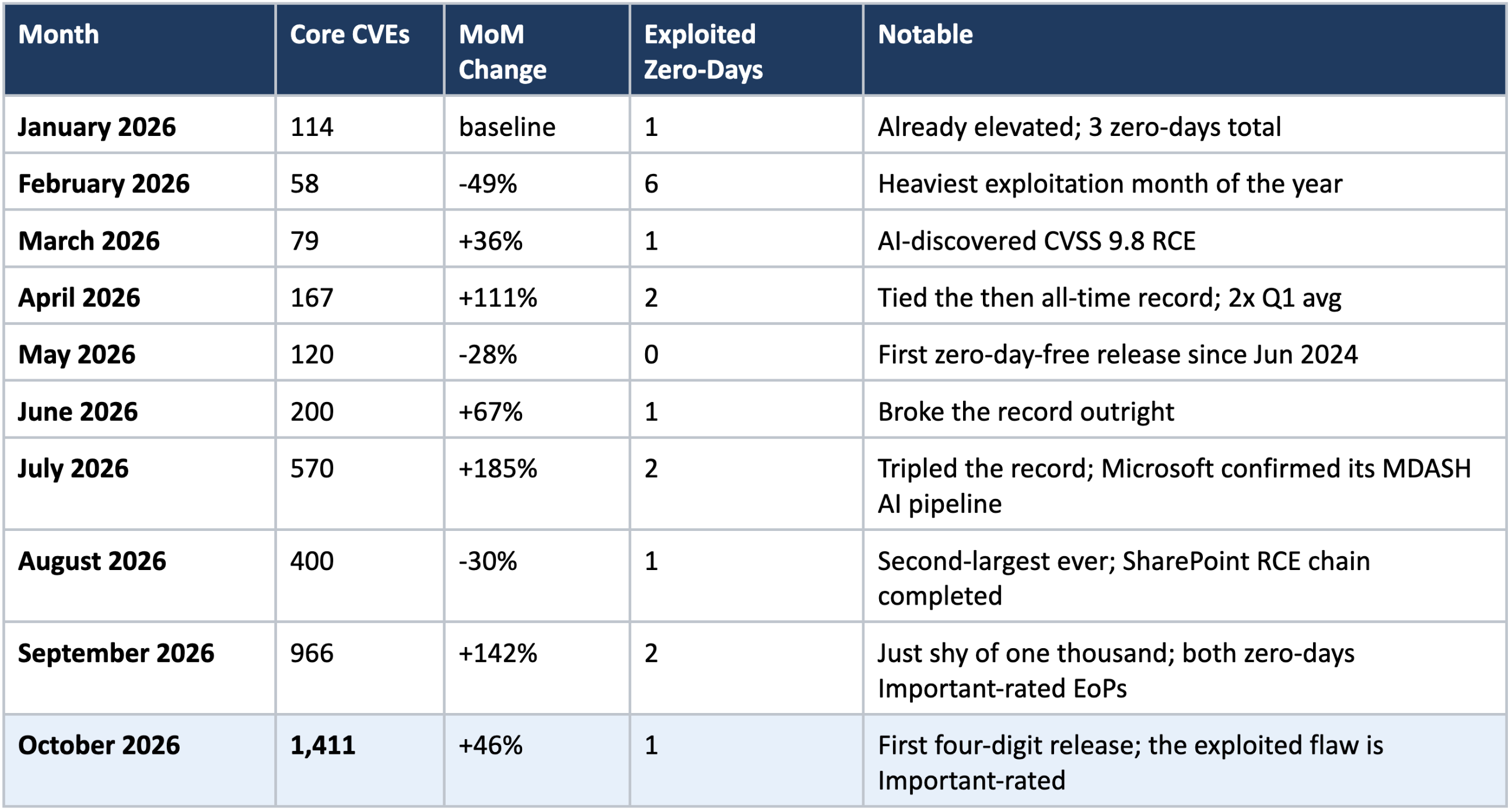
October 2026 Patch Tuesday arrived on October 13 with 1,411 CVEs, the first four-digit release in Microsoft's history and the fourth record in five months. One flaw is under active exploitation, a Windows Shell bypass of Mark of the Web protections that Microsoft rates Important rather than Critical, which means none of the 70 Critical-rated vulnerabilities in this release has been seen in an attack. Two more flaws were publicly disclosed before patches shipped, one in .NET Framework that bypasses Windows Defender Application Control and one in the MessagePack-CSharp library. The year-to-date count now stands at roughly 4,085, about double the full-year figure Tenable's Satnam Narang projected back in July and well past his outer estimate of three thousand. Anyone still using the monthly CVE total as a measure of risk should retire it this month. The total measures how fast vendors can find flaws, and finding flaws is no longer the hard part. We updated our monthly analysis with verified October data, and this edition also covers what Anthropic's October 6 announcement changes about the Glasswing story this series has followed since April.
This is the seventh edition of our monthly vulnerability landscape analysis. For new readers, the background: on April 7, Anthropic announced Project Glasswing and Claude Mythos Preview, a model capable of autonomously finding and chaining zero-day vulnerabilities at a scale that previously required elite human researchers. Vendors responded by industrializing AI discovery themselves, and the releases followed. April tied the old record, June broke it, July tripled it, August delivered 400 and the industry called it quiet, September posted 966, and October cleared one thousand by more than 400.
Last month's edition closed with one capacity instruction: build the plan for a thousand-CVE month, because September came within 34 of it. October delivered 1,411. It also confirmed the calendar item we flagged, with Windows 11 24H2 Home and Pro and Windows 10 Enterprise LTSB 2016 receiving their last update on October 13. We also said the Glasswing report remained outstanding. It still has not appeared in the form Anthropic had described, but press coverage of Anthropic's October 6 announcement reported new program figures, and they are worth reading closely.
Here is the verified monthly data and what it means for your exposure management program.
The Numbers: One Thousand Four Hundred Eleven
Each month we pull vendor advisory data and cross-reference it against independent analysis. The methodology spread continues. BleepingComputer counts 1,411 CVEs released on the day, with 70 rated Critical, of which 57 are remote code execution, 11 elevation of privilege, and 2 spoofing. BleepingComputer's count generally leaves out cloud fixes Microsoft shipped earlier in the month, such as Azure App Service, Azure Event Grid, and Dataverse. Tenable counts 1,407 with 69 Critical, Automox counts 1,408 with 78 Critical, Dark Reading and The Hacker News count 1,413, and ZDI counts 1,415. Wherever you land inside that eight-CVE spread, this is the largest security release any vendor has ever shipped, and the first one with four digits. Security Affairs, quoting ZDI, calls it "the first four-digit volume we have ever seen."
By category, BleepingComputer's breakdown shows elevation of privilege at 677 flaws, nearly half the release, followed by remote code execution at 317, information disclosure at 254, denial of service at 73, security feature bypass at 40, and spoofing at 28. By product, Dark Reading's tally puts Windows at 1,102 CVEs, Office at 134, developer tools at 61, SharePoint Server at 36, SQL Server at 22, Azure at 15, and Exchange Server at 7. ZDI counts 59 potentially wormable flaws while acknowledging that some descriptions are ambiguous, and other trackers land on 55. Automox counts 108 flaws that Microsoft rates as more likely to be exploited, against 58 last month.
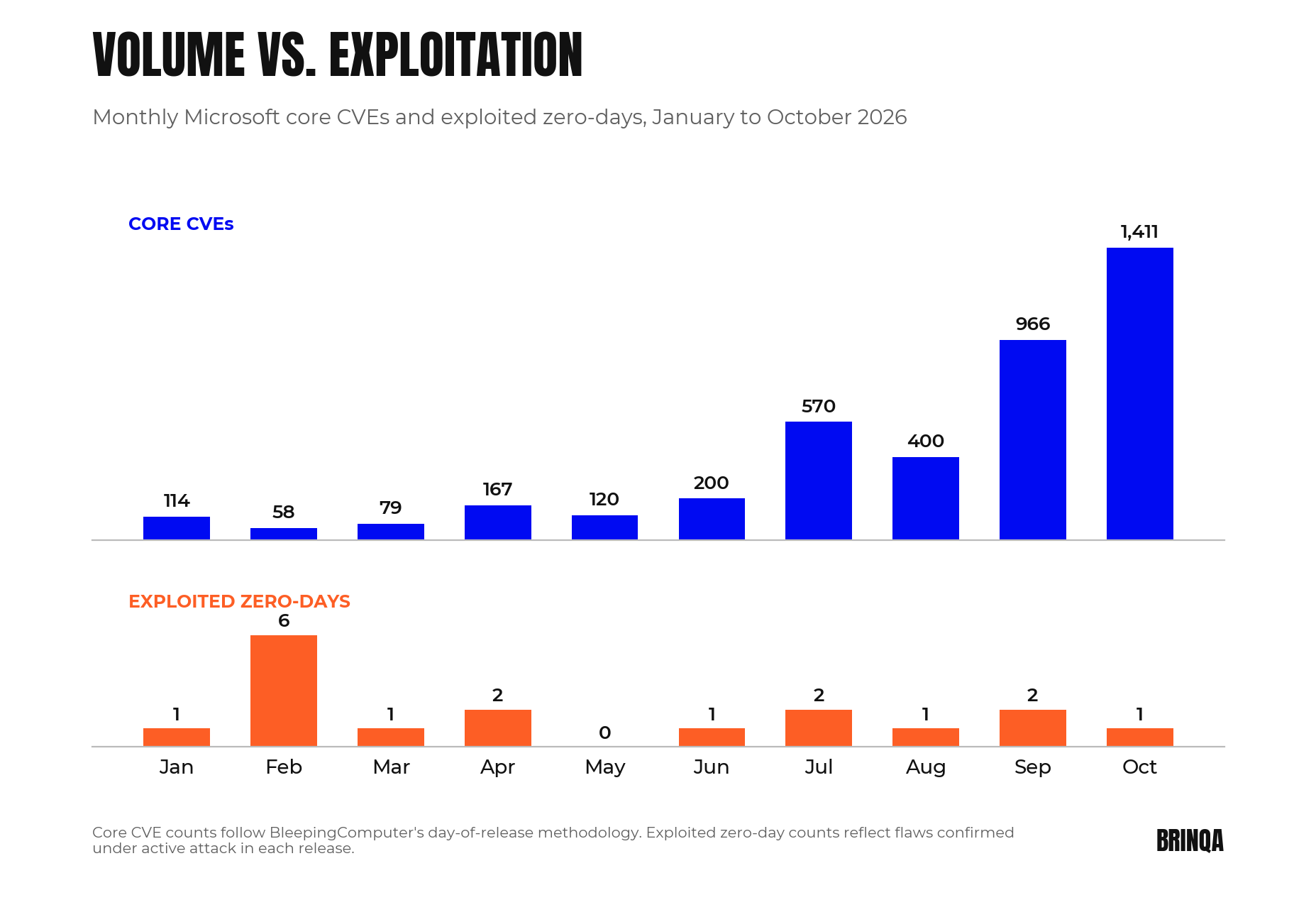
The trendline through ten months of 2026, shown against exploitation:
Core counts follow BleepingComputer's day-of-release methodology for month-over-month consistency. October counts from Tenable (1,407), Dark Reading and The Hacker News (1,413), and ZDI (1,415) reflect differing inclusion rules. Exploited zero-day counts reflect flaws confirmed under active attack at release.
October runs 16.8 times the Q1 monthly baseline of 84. The year-to-date total of roughly 4,085 core CVEs is more than three times Microsoft's previous full-year record of 1,245, and Tenable's Narang now cites more than 4,000 CVEs patched by Microsoft this year alone. That is about double the two thousand CVEs Narang projected for the full year in July.
Microsoft also published 15 experimental risk cohorts that group the release by affected area, such as 136 flaws in Windows filesystems, storage, and backup and 135 in Office documents and mail clients. BleepingComputer notes that these groups do not necessarily indicate which flaws are the most dangerous. When the vendor has to sort its own advisory into fifteen piles to make it navigable, the flat list has stopped working as a work queue.
Nine Fires in 3,834 Findings
Since the Glasswing announcement, Microsoft has shipped 3,834 core CVEs across seven releases, at 167, 120, 200, 570, 400, 966, and now 1,411. Nine of them were confirmed exploited at release, which works out to 0.23 percent. Fortra's Tyler Reguly reaches a similar place from CISA data: only 26 Microsoft CVEs from 2026 appear in the Known Exploited Vulnerabilities catalog, compared with 30 for all of last year and 32 the year before, which he summarizes as "less than 1% of vulnerabilities patched by Microsoft this year are known to be exploited." Microsoft's 2026 volume has already passed its previous full-year record more than three times over, while the count of its flaws that attackers are confirmed to use sits below the full-year totals of the previous two years.
Core CVE counts follow BleepingComputer's day-of-release methodology. Exploited zero-day counts reflect flaws confirmed under active attack in each release.
The caution from earlier editions still applies. The capability to weaponize these flaws exists, and the flat trend reflects attacker adoption lag. That is why the planning conclusion has two sides. Automate the volume, because it is permanent, and reserve human attention for the handful of flaws with evidence of attack, reach, or chaining. The count remains useful for sizing capacity and has stopped being useful for ranking risk.
One Exploited Zero-Day, Rated Important, Delivered by a File
CVE-2026-96951 is a Windows Shell flaw with a CVSS score of 8.8 that lets an attacker bypass Mark of the Web, the marker Windows attaches to files that arrive from the internet so that SmartScreen, Protected View, and the macro block can treat them with suspicion. Microsoft classifies the weakness as command injection and confirms exploitation in the wild before a patch existed. Tenable describes the likely delivery as social engineering through email or messages that gets a target to open a malicious file. CISA added the flaw to its Known Exploited Vulnerabilities catalog with a federal remediation deadline of October 16, three days after release.
It is the third Windows Shell flaw exploited in the wild this year, following CVE-2026-21510 in February and CVE-2026-32202 in April. Microsoft's credit line includes researchers at Fujitsu and Anthropic, among others, and the company has not said how attackers used the flaw or whom they targeted. The exploited flaws in August, September, and October were all rated Important, so an emergency process keyed to Critical severity would have skipped each of them. A Mark of the Web bypass is a chain link. It takes a file that should have raised a warning and removes the warning so something else can do the damage, and its value to an attacker lies in what it chains with rather than in what it scores alone.
The two publicly disclosed flaws belong in your first deployment wave because disclosure starts the clock on working exploit code.
- CVE-2026-108398: A .NET Framework untrusted search path flaw, found by James Forshaw of Google Project Zero, that lets an attacker bypass Windows Defender Application Control and run code inside a process WDAC is meant to protect. It carries a CVSS score of 8.8. Dark Reading reports that it requires local access and a low-privilege account, and Microsoft rates exploitation less likely. There is no official workaround, so patching is the control.
- CVE-2026-92707: A denial of service flaw in MessagePack-CSharp with a CVSS score of 5.3. The score is modest, but the library is a serialization component bundled inside other applications, which makes it a software inventory question as much as a patching one.
Both the Mark of the Web bypass and the WDAC bypass undermine controls that hardening baselines lean on. If your program counts either control as a mitigating factor for other exposures, this is the month to confirm that it still does what the baseline says.
Notable Vulnerabilities Beyond the Zero-Days
- Email and the reading pane. CVE-2026-70242 is a Critical Outlook remote code execution flaw with a CVSS score of 9.8, where a crafted email triggers a heap overflow with no user interaction. Automox notes that Microsoft rates exploitation less likely and reports none so far. Email is also the likely delivery path for the exploited Shell flaw, so these two belong in the same deployment wave.
- Network-reachable 9.8s. CVE-2026-105016 is an unauthenticated heap overflow in Microsoft QUIC, triggered by a crafted IPv6 packet with no user interaction, affecting Windows 11, Windows Server, .NET, and Visual Studio. MSMQ (CVE-2026-100202) and the PostScript printer driver (CVE-2026-70147 and CVE-2026-70153) carry the same score. None is confirmed exploited, and all sit on services that are widely deployed and easy to forget.
- The server ring. Exchange Server received four separate on-premises updates, each fixing a CVSS 8.8 flaw, and Tenable flags CVE-2026-70571, a Critical remote code execution flaw that a malicious email can trigger. Active Directory Domain Services has a Critical remote code execution flaw (CVE-2026-70229) reachable with a crafted packet. SQL Server's CVE-2026-65674 is a deserialization remote code execution flaw that Dark Reading reports ZDI rated the most exploitable SQL Server bug of the month. SharePoint's CVE-2026-102866 allows privilege escalation through improper signature verification in its token validation, and after August's chain, SharePoint has earned your attention by default.
- The wormable surface. ZDI's 59 potentially wormable flaws cluster in network services such as DHCP Server and Remote Desktop Gateway. These are the services that attackers can reach without a user doing anything, which is the profile that matters most for lateral movement.
- Thumbnails. CVE-2026-21413, a Raw Image Extension remote code execution flaw with a CVSS score of 9.8, was republished by Microsoft from Cisco Talos research and can trigger when Windows generates a thumbnail, without the file ever being opened.
What the Security Industry Is Saying
Zero Day Initiative, Dustin Childs, Head of Threat Awareness (October 2026): As quoted by Dark Reading, Childs said, "Hundreds of CVEs in a single release used to be the exception; now it's the baseline," and added that the volume is no longer the real story. His triage advice fits on one line: "Patch what's proven, prioritized, and public, and treat everything else as this month's new normal." ZDI also acknowledged that AI is "clearly helping researchers find bugs faster, both for attackers and defenders."
Fortra, Tyler Reguly, Associate Director of Security R&D (October 2026): Reguly has argued that raw CVE counts are misleading and used the October release to make the case with CISA data, noting that fewer than one percent of the Microsoft vulnerabilities patched this year are known to be exploited.
Tenable, Satnam Narang, Senior Staff Research Engineer (October 2026): Narang's tally shows 26 Windows Shell vulnerabilities patched this year, against three in 2025, and more than 4,000 Microsoft CVEs patched this year alone. The Hacker News counts the exploited flaw as the third Windows Shell vulnerability exploited in the wild in 2026.
Automox (October 2026): Automox's analysis structured its guidance around one principle: "Exploitation status outranks the CVSS score, the severity label, and everything else in triage." It recommends verifying the fix by OS build number rather than by deployment success, and checking Office builds directly because Windows patch status does not report them.
The commentary has now moved past debating whether the volume is real. Counting houses that built their reputations on precision are telling readers to look elsewhere, and the guidance converging across vendors, analysts, and this series is the same: prioritize by evidence of exploitation and environmental context, automate the rest, and confirm the fixes that matter held.
The Last Five Weeks
Much of the exploitation we can see between releases sits outside the Microsoft release. BleepingComputer's October roundup of other vendors reads like a ledger of edge infrastructure: a Citrix NetScaler flaw (CVE-2026-88779) exploited as a zero-day before patching, a Fortinet FortiMail flaw (CVE-2026-104286) exploited in zero-day attacks, an actively exploited zero-day in Ivanti Connect Secure, a SonicWall SMA1000 request forgery flaw exploited within two days of disclosure, and Atlassian's CVE-2026-21589 across Confluence, Jira, and Bitbucket Data Center, exploited after a public proof of concept. Microsoft's headline number grew 46 percent this month, and a good share of the attacks defenders are actually working sit on devices that do not appear in the Patch Tuesday count at all.
Adobe shipped 10 bulletins covering 141 CVEs on October 13, with 15 rated critical, including ten critical flaws in ColdFusion (APSB26-144), three of them unauthenticated and rated 9.8 or higher. Adobe issues on the second and fourth Tuesdays, so its next installment lands October 27. On the lifecycle side, Windows 11 24H2 Home and Pro and Windows 10 Enterprise LTSB 2016 are now out of updates, and Windows 11 23H2 Enterprise, Education, and IoT Enterprise follow next month, which puts migration work on the same teams absorbing record volume.
The Glasswing Watch: The Report Changed Shape
On October 6, Anthropic folded Project Glasswing into an expanded Cyber Verification Program with three access tiers: Defense Access for security operations and incident response, Red Team Access for authorized penetration testing, and Specialized Access, with the fewest cyber blocks, for verified organizations testing safety-critical systems. Existing Glasswing members move to Specialized Access without reapproval for current models, and Claude Opus 5.5, Sonnet 5.5, and Mythos 5.1 are available at every tier. Generally available models keep conservative classifiers that block most cyber work, so the widest capability still sits behind verification.
Alongside the announcement, Anthropic put numbers on the program, as reported by Help Net Security and The Hacker News: at least 129,000 verified vulnerabilities found by partners between April and July, another 5,500 from its own open-source scanning through October, and more than 33,000 rated critical or high severity. Anthropic says the 33,000 figure is likely an undercount because it relies on survey data from only some partners, and fewer than half of partners disclosed patch counts. We have not found a standalone 90-day report, so as far as we can verify, the summary report Anthropic had indicated would follow has still not appeared in the form described.
The more useful numbers come from outside. According to VulnCheck's Patrick Garrity, as reported by SecureWorld, Anthropic has reported 26,153 findings, 2,736 of them have reached its public disclosure ledger, and 202 are marked fixed. Of 300 CVEs credited to Anthropic or Glasswing researchers, 2 have been exploited in the wild. The datasets differ and cannot be compared directly, but together they describe the same two-curve picture this series has tracked at the vendor level: an enormous number found, a small number fixed, and a smaller number exploited. For capacity planning, the September conclusion holds. The disclosure queue is not shrinking, and the discovery engine keeps getting wider access.
Nobody Is Reading 1,411 Advisories
Your scanners tell you what exists. This month that means 1,411 new Microsoft CVEs on top of every other vendor's output. The question that decides your week is much narrower: which of these can hurt the business right now? One is being attacked, and it carries an Important rating. If your emergency process triggers on Critical severity, it would have rushed 70 patches and left the one with a three-day federal deadline in the monthly queue. Severity scores also undersell the flaws that need fast attention for other reasons, including the publicly disclosed WDAC bypass, the 108 flaws Microsoft rates as more likely to be exploited, and the wormable network services.
Deciding what to fix first still comes down to four questions. Is it being attacked? Can attackers reach it? Is it part of a known attack chain? Does it sit on something the business depends on? October answers the first with a single CVE. The other three depend on your environment, which is why the answer cannot come from the advisory, and why a vendor grouping the list into cohorts, however helpful, cannot do that work for you.
Where Brinqa Fits in This Environment
The Brinqa Platform consolidates findings from 300+ security tools into unified exposure records and correlates them against asset context, business criticality, compensating controls, and real-world exploit intelligence. That correlation turns a record month into a prioritized, defensible work queue.
Take this month's exploited flaw. The questions that matter are which users and endpoints receive files by email and chat, which of those assets are business-critical, and whether any of your compensating controls assume Mark of the Web works. Those are questions about context that a flat CVE list cannot hold. Brinqa's AI Deduplication Agent collapses overlapping scanner findings into one exposure record, ownership inference identifies likely owners for unassigned findings, and SmartFlow routes work to the right teams with SLAs and escalation, so the one flaw with a three-day deadline gets an owner on day one.
PlexTrac by Brinqa covers the other half of the loop. Offensive security teams can validate whether the Mark of the Web and WDAC controls still hold in your environment, and scheduled retesting can prove whether the fix held once implemented. Validated closure means the fix was retested and held.
Five Recommendations Before the November Window
1. Patch CVE-2026-96951 first, and let exploitation status route it.
CISA's federal deadline is October 16, and the flaw is exploited now in a core Windows component. Verify the fix by OS build number rather than by deployment success, alert on suspicious child processes spawned from Explorer and Office, and tighten email gateway filtering until the patch is confirmed everywhere. Because exploitation depends on a user opening a file, pair the patching with a review of recent downloaded-file activity.
2. Put Outlook and the server ring in the first wave.
CVE-2026-70242 triggers from the reading pane with no user interaction, and Exchange, SQL Server, SharePoint, and Active Directory Domain Services each carry flaws that ZDI, Tenable, or Dark Reading singled out. Patch Office separately and verify the installed Office build directly, since Windows patch status does not report it.
3. Validate the controls the zero-days undermine.
Mark of the Web and WDAC are both in play this month. If your hardening baseline or your risk scoring treats either as a mitigating factor, test whether they hold in your environment before and after patching, and retest the fix. Do this as a standing step rather than an annual exercise, because a baseline that was true in September may not be true in October.
4. Change the number on your dashboard.
Patches deployed is a volume metric, and volume is permanent. Track the measure we have recommended since May: time from a confirmed exploitable exposure appearing to its validated closure. Report that separately for exploited and publicly disclosed flaws and for the bulk of routine ones. If closing this month's one exploited flaw takes as long as closing a hundred routine ones, your automation is aimed at the wrong end.
5. Plan November around the calendar you can see.
Oracle's quarterly update arrives October 20, Adobe's next installment lands October 27, Windows 11 23H2 Enterprise, Education, and IoT Enterprise lose security updates next month, and Mythos-class access is widening through Anthropic's verification tiers. Build the capacity plan for another four-digit month. October is the evidence that last month's plan was too small.
October did what this series said the AI era would do. It produced a number so large that the people who count professionally have stopped treating it as meaningful, and it placed its one confirmed threat behind a rating that a severity filter would pass over. Seven editions in, the lesson has not changed and has become easier to say: find everything, work out which handful can hurt you, fix those first, and prove the fixes held. The count will keep rising. The programs that stay calm at fifteen hundred CVEs a month will be the ones that stopped using it to decide anything.
We will publish the November edition on the next Patch Tuesday, November 10.
If you're working through what AI-driven CVE volume means for your program, or what validated exposure management looks like in practice, speak with a Brinqa Expert about where it stands today.
FAQs
It is the largest security release ever shipped and the first with four digits, at 1,411 CVEs by BleepingComputer's count, yet only one flaw is confirmed under attack and it is rated Important rather than Critical. The month confirms that programs need to prioritize by exploitation evidence and environmental context, automate the bulk of the volume, and validate that the fixes for the flaws that matter held.
Vulnerability prioritization this month starts with CVE-2026-96951, the actively exploited Windows Shell Mark of the Web bypass, which CISA gave federal agencies until October 16 to fix. Follow with the two publicly disclosed flaws, CVE-2026-108398 in .NET Framework and CVE-2026-92707 in MessagePack-CSharp, then the Outlook reading pane flaw (CVE-2026-70242) and the Exchange, SQL Server, SharePoint, and Active Directory flaws that analysts flagged.
Because exploitation is evidence and volume is not. Across seven releases since April, Microsoft has shipped 3,834 core CVEs, and nine were confirmed exploited at release. Only 26 of Microsoft's 2026 CVEs appear in CISA's Known Exploited Vulnerabilities catalog, according to Fortra's Tyler Reguly. The count measures how quickly flaws are found, which is a capacity question for your team and a weak signal of danger.
Not proportionally. Monthly volume is now 16.8 times the first-quarter baseline, while confirmed zero-day exploitation per release has stayed between zero and two all year. VulnCheck's analysis found that 2 of 300 CVEs credited to Anthropic or Glasswing researchers have been exploited in the wild. The capability to weaponize flaws exists, so the gap reflects adoption lag, and the practical challenge is separating a small number of real fires from a very large number of findings.
On October 6, Anthropic folded Glasswing into an expanded three-tier Cyber Verification Program, and press coverage reported program figures including at least 129,000 verified vulnerabilities found by partners between April and July. A standalone 90-day report has not appeared as far as we can verify, and fewer than half of partners disclosed patch counts, so how many of those findings have been fixed remains unclear.
Brinqa consolidates findings from more than 300 security tools into unified exposure records, prioritizes them by exploitation activity, reachability, business criticality, and compensating controls, routes them to owners with deadlines and escalation, and, with PlexTrac by Brinqa, validates both exploitability and remediation. The result is a short, defensible priority list and evidence that the fixes held.
Windows 11 version 24H2 Home and Pro and Windows 10 Enterprise LTSB 2016 received their last security update on October 13. Windows 11 23H2 Enterprise, Education, and IoT Enterprise stop receiving security updates next month.
SOURCES AND REFERENCES
1. BleepingComputer, Microsoft October 2026 Patch Tuesday fixes 1,411 flaws, 3 zero-days, October 13, 2026. bleepingcomputer.com
2. Tenable, October 2026 Microsoft Patch Tuesday (1,407 CVEs), October 13, 2026. tenable.com
3. The Hacker News, Microsoft Patches Record 1,413 Flaws, Including Exploited Windows Shell Bug, October 2026. thehackernews.com
4. Dark Reading, Zero-Days Lurk in Microsoft's Overgrown October Patch Tuesday, October 2026. darkreading.com
5. CSO Online, October Patch Tuesday roundup: Over 1,400 Microsoft holes to be plugged, including three zero days, October 2026. csoonline.com
6. Security Affairs, Microsoft Patch Tuesday Sets New Record with 1,415 CVEs in October 2026 Updates (quoting Zero Day Initiative), October 2026. securityaffairs.com
7. Automox, Patch Tuesday October 2026: CVE Analysis, October 2026. automox.com
8. Petri, Microsoft Releases October 2026 Patch Tuesday Updates, October 2026. petri.com
9. Anthropic, Expanding the Cyber Verification Program, October 6, 2026. anthropic.com/news/cyber-verification-program
10. SiliconANGLE, Anthropic folds Project Glasswing into an expanded three-tier Cyber Verification Program, October 6, 2026. siliconangle.com
11. Help Net Security, Anthropic loosens Claude's cyber restrictions for verified defenders, October 7, 2026. helpnetsecurity.com
12. The Hacker News, Anthropic Expands Claude Access for Vetted Cyber Teams as Glasswing Finds 129,000 Flaws, October 7, 2026. thehackernews.com
13. SecureWorld, Anthropic Widens Access to Bug-Hunting AI. Remediating Is Still the Hard Part, October 2026. secureworld.io
14. Brinqa Research Team, Patch Tuesday editions for April through September 2026 (prior-edition data and the Brinqa acquisition of PlexTrac, August 19, 2026). brinqa.com/blog
15. Oracle, Critical Patch Update schedule (October 20, 2026 release). oracle.com/security-alerts
16. Computerworld, Adobe premieres a second Patch Tuesday each month to deliver fixes faster (second and fourth Tuesday schedule). computerworld.com