AI Deduplication Agent: AI That Eliminates One of Exposure Management’s Most Persistent Conflicts
by Brad Hibbert, COO & CSO//
Here’s a problem most security teams have learned to live with: your scanners don’t agree with each other.
Different tools, different taxonomies, different severity ratings for the same underlying issue. Every alert is real, every finding lands in your queue and demands attention. But when four of them describe the same underlying vulnerability, knowing which one to act on, and which one actually represents distinct risk, becomes an investigation in itself before any remediation work has even started.
The scale of this problem is significant. IDC research shows large enterprises ignore roughly 30% of their alerts entirely because they simply cannot keep up with the volume. The average enterprise SOC processes over 11,000 alerts per day. When a meaningful portion of those represent the same underlying exposure reported by different scanners, the compounding effect on prioritization, remediation velocity, and risk-based vulnerability management is severe.
This is one of the most quietly damaging problems in exposure management. It distorts metrics, creates redundant tickets, slows remediation, and erodes trust in the data that’s supposed to drive decisions.
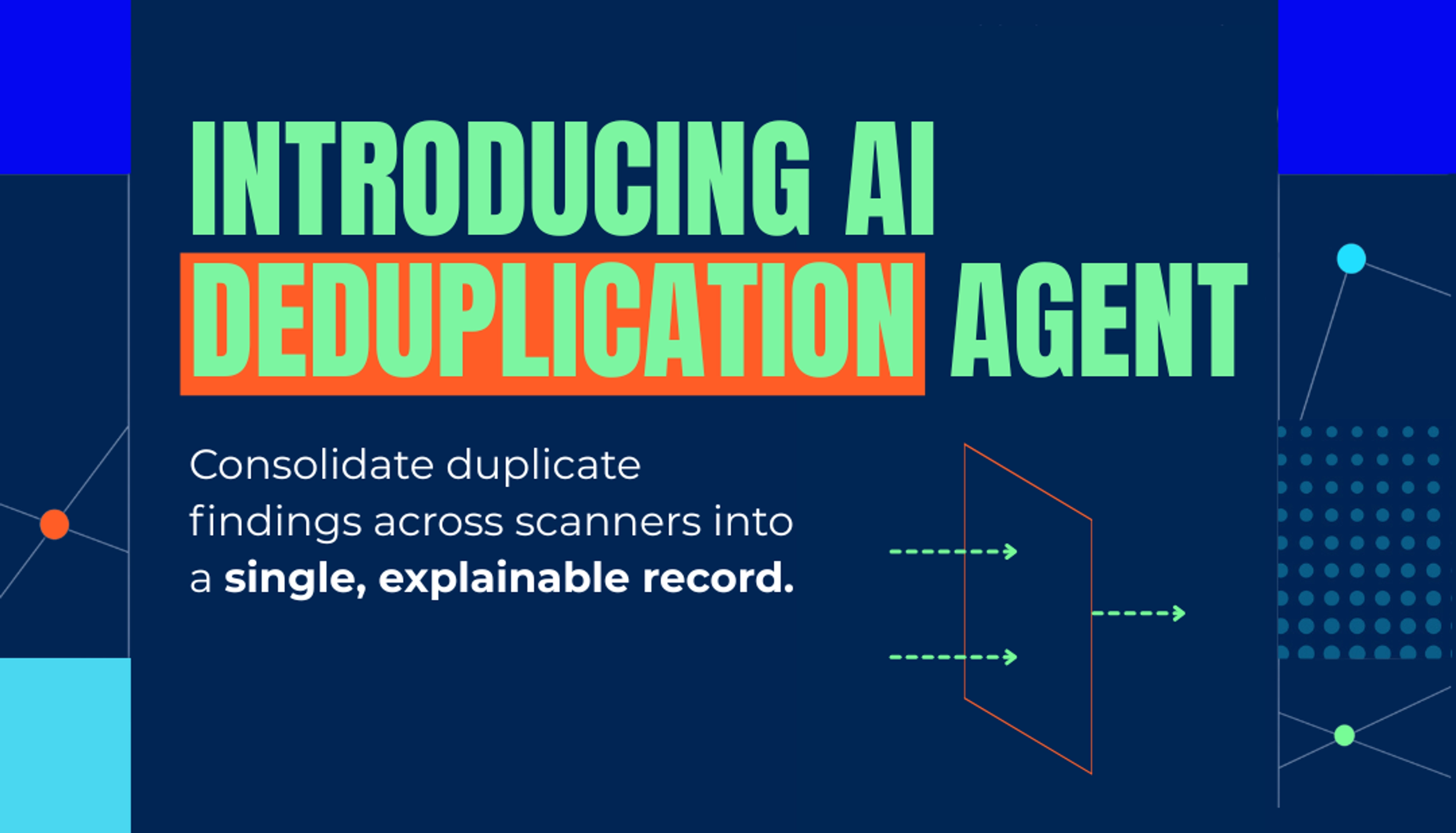
AI Deduplication Agent is the latest release from Brinqa’s AI Center of Excellence. It’s an AI-powered decision engine built directly into the Brinqa Platform that identifies and merges duplicate vulnerability findings into a single, enriched, and fully auditable record. Your team can stop managing redundancy and start managing risk.
This release marks another significant step in Brinqa’s vision for agentic exposure management: AI that actively participates across the exposure lifecycle, intelligently, transparently, and at scale.
Why Duplicate Findings Are More Than a Nuisance
In most enterprise environments, no single scanner sees everything. Teams deploy multiple tools, including vulnerability scanners, cloud security platforms, CSPM tools, DAST, and SAST, to get full coverage. That strategy makes sense. But it also means the same vulnerability gets reported in different ways, under different names, with different severity scores, depending on the tool.
This is not a fringe problem, every enterprise running multiple scanners deals with it. A single vulnerability can appear as multiple separate findings across three different tools, each with its own name, severity rating, and suggested remediation path. Security teams end up triaging the same issue multiple times without realizing it. That’s not security work, that’s spreadsheet archaeology.
The downstream effects compound across every team involved:
- Security teams waste time investigating findings that are already known, just reported differently
- Remediation teams receive multiple, sometimes conflicting, tickets for the same issue
- Risk scores become inflated and unreliable when the same exposure is counted multiple times
- SLA tracking breaks down when the same finding appears across separate records
- Executive reporting loses credibility when the numbers don’t reflect reality
- Vulnerability prioritization becomes unreliable when the same exposure carries different severity scores across tools
Manual deduplication has never been a realistic answer. It doesn’t scale, it’s inconsistent, and static matching rules can’t keep pace with the way modern vulnerability data actually behaves. AI Deduplication Agent solves this at the source, automatically and continuously.
AI That Eliminates the Static, Automatically
Vulnerability deduplication is the process of identifying and consolidating duplicate findings across multiple security tools into a single, authoritative record. AI Deduplication Agent is Brinqa’s AI-native approach to this problem, built directly into the platform’s ingestion and normalization pipeline rather than applied as a downstream layer.
It uses a combination of machine learning and LLM-based inference to analyze all data sources connected to the platform, identify findings that describe the same underlying issue, and merge them into a single, consolidated record.
Critically, this isn’t simple identifier matching. The agent intelligently correlates findings even when taxonomies, severity ratings, and naming conventions don’t align across tools. It understands context, specifically what the finding actually describes, and uses that understanding to make accurate merge decisions at scale.
The result is a dramatically cleaner and more accurate view of exposure, without losing any of the detail, context, or auditability that teams need to act on it.
How AI Deduplication Agent Works
Intelligent Cross-Source Correlation
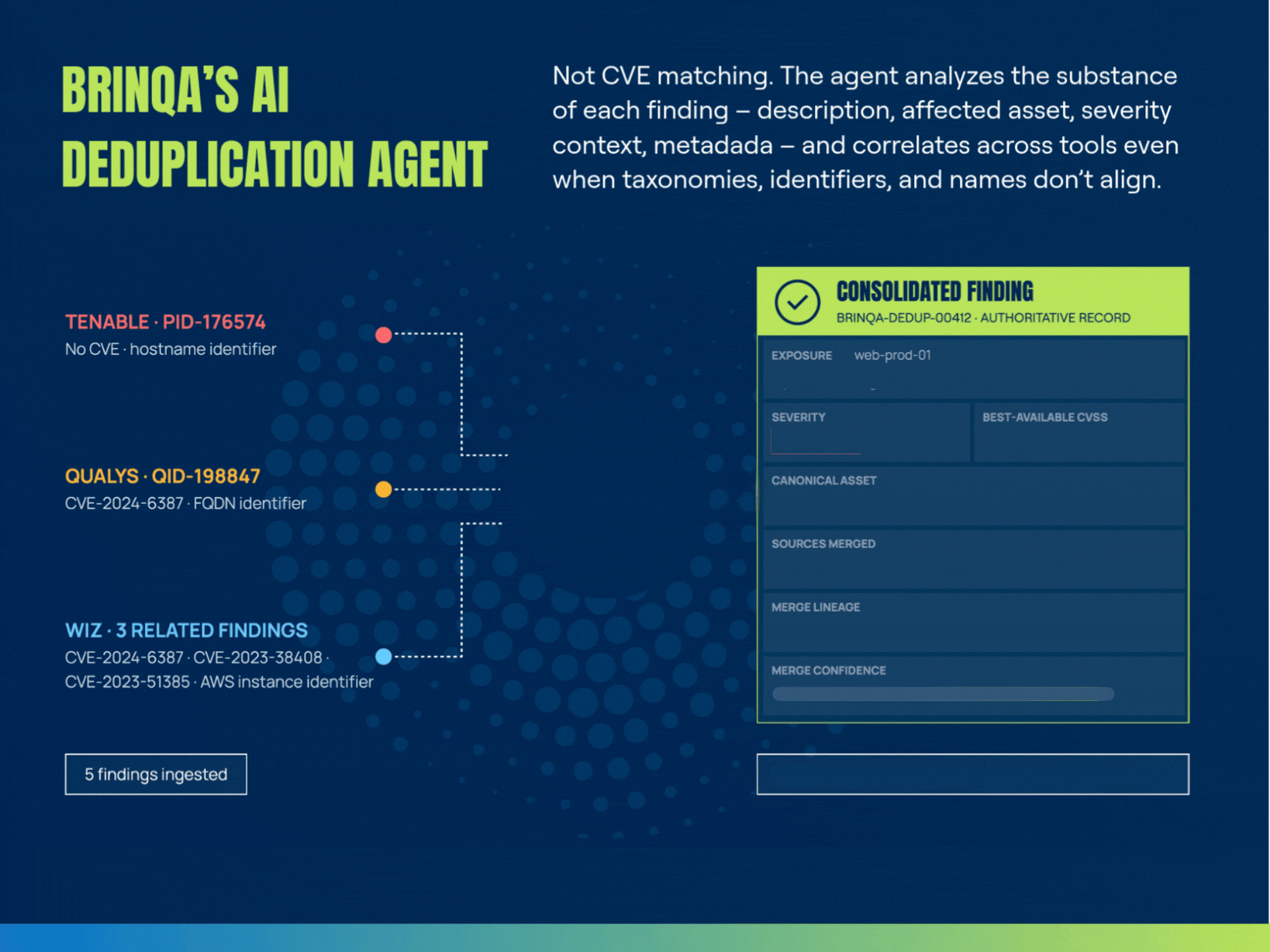
AI Deduplication Agent ingests findings from all connected data sources and applies machine learning and LLM-based inference to identify which findings represent the same underlying exposure. Rather than relying on static identifiers, the agent analyzes the substance of each finding, including its description, affected asset, severity context, and associated metadata, to make correlation decisions that reflect how the vulnerability actually manifests across tools.
Merging into a Single, Enriched Record
When duplicates are identified, AI Deduplication Agent merges them into one consolidated record that preserves the richest available data from all contributing sources. No detail is lost. The merged record carries forward the full context from every scanner that reported the finding, giving teams a richer view than any single source provides on its own.
Full Auditability and Transparency
Every merge decision retains full lineage to the original source records, preserving traceability across all contributing findings.Teams can see which findings were merged, why, and what data contributed to the consolidated record. This transparency is foundational to how the agent is designed. Organizations need to trust the data, not just accept it.
Continuous Operation at Scale
AI Deduplication Agent runs continuously as new findings are ingested, with no performance overhead to existing assessment runs. As your environment grows and your scanner footprint expands, deduplication keeps pace automatically.
What This Means for Security and Remediation Teams
The value of AI Deduplication Agent isn’t abstract. It shows up directly in how teams work and what they’re able to accomplish:
- Fewer findings to investigate. When duplicates are merged at ingestion, the total finding count reflects actual unique exposures, not the sum of every scanner’s output. Teams spend less time triaging and more time remediating.
- Clearer remediation instructions. A single consolidated record with clear, unified context replaces the confusion of conflicting or redundant tickets. Remediation teams know exactly what they’re fixing and have the full picture to act on it.
- More accurate risk scoring and vulnerability prioritization. When the same vulnerability isn’t counted three times, risk scores reflect reality. Prioritization decisions become more reliable, and the highest-impact exposures rise to the top without redundant findings obscuring them.
- Better metrics and executive reporting. Finding counts, SLA performance, and remediation velocity all become more meaningful when the underlying data is deduplicated. When you tell leadership there are 5,000 critical findings, it means there are 5,000 critical findings, not 1,200 real ones echoed across four different scanners.
- A cleaner foundation for ownership routing. Deduplicated records are simpler to route and easier to action. While ownership assignment is the domain of AI Attribution Agent, cleaner, consolidated findings reduce the ambiguity that slows handoffs between security and remediation teams.
- Stronger downstream intelligence. Cleaner data improves everything built on top of it, including every automated workflow that depends on finding quality.
The impact compounds across teams. Security reduces investigation time. IT and engineering receive clearer remediation guidance. Leadership gets cyber risk scoring and metrics they can trust. The entire exposure program moves faster and with more confidence.
How Brinqa’s Approach Is Unique
Most deduplication approaches rely on static rules or exact identifier matching. They work for the easy cases and miss the rest. Brinqa’s AI Deduplication Agent is designed for the way real environments actually work.
- Intelligence beyond identifiers. By combining machine learning with LLM-based inference, the agent correlates findings based on their actual meaning, not just whether CVE numbers match. This handles the ambiguity that static rules cannot.
- No detail lost in the merge. Deduplication should simplify without erasing. The consolidated record preserves full context and provenance from every contributing source.
- Explainable and auditable by design. Every decision is tagged, traceable, and reviewable. Teams maintain complete governance over what was merged and why.
- Native to the platform pipeline. AI Deduplication Agent operates within Brinqa’s ingestion and normalization pipeline, not as a bolt-on layer. Clean data flows downstream automatically to consolidation, scoring, workflows, and analytics.
- Built for unified exposure management. AI Deduplication Agent is one component of Brinqa’s unified exposure management platform. Clean, deduplicated findings feed directly into risk scoring, prioritization, and remediation workflows, creating a coherent, trustworthy picture of cyber risk posture across the entire environment.
- Aligned with CTEM. AI Deduplication Agent is particularly well-suited to the prioritization, validation, and mobilization stages of a CTEM program, where finding data quality has the most direct impact on outcomes. Deduplication drives cleaner prioritization, gives teams a single consolidated record to validate against rather than reconciling conflicting signals, and makes mobilization faster by routing one clear, actionable finding into ticketing and remediation workflows instead of a cluster of duplicates.
Discovery benefits too, since a cleaner inventory makes true exposure scope easier to assess. But it is in those three downstream stages where deduplication most directly accelerates program performance.
Part of a Broader Vision for Agentic Exposure Management
AI Deduplication Agent along with AI Attribution Agent are complementary capabilities that together address one of the most foundational challenges in exposure management: data you can actually trust.
AI Attribution Agent fills in data gaps and improves data quality, ensuring that critical attributes are complete and consistently populated. AI Deduplication Agent ensures findings are accurately consolidated across sources. Together, they remove the friction that has historically slowed every downstream process, including risk scoring, ticket routing, remediation workflows, and executive reporting.
This is what proactive security looks like in practice: AI that participates actively and intelligently at the right layers of the pipeline, improving program performance in ways that scale with the complexity of the environment. It’s a fundamentally different operating model than reactive vulnerability management, and it’s what separates organizations that are managing cyber risk exposure from those still drowning in alert volume.
As exposure management programs become continuous and intelligence-driven, the quality of the data underneath them is not a secondary concern. It’s the foundation everything else depends on. AI Deduplication Agent ensures that foundation is solid.
More AI-powered innovations from Brinqa’s AI Center of Excellence are on the way as we continue to redefine what exposure management can be.
If you’d like to see how Brinqa’s AI-powered exposure management platform works in real environments, schedule time to meet with a Brinqa Expert.
FAQs
AI Deduplication Agent solves the problem of duplicate vulnerability findings across scanning tools, one of the most persistent and underappreciated challenges in exposure management. When multiple scanners report the same issue differently, under different names, severity ratings, or taxonomies, findings accumulate without reflecting additional unique risk. The agent consolidates these duplicates into a single, enriched record, giving teams an accurate view of their true exposure footprint without the redundancy.
CVE-based matching only works when findings share a common identifier, which is frequently not the case across tools with different taxonomies or for vulnerabilities without assigned CVEs. AI deduplication goes beyond CVEs to include other exposures including CWEs, and vendor specific findings. AI Deduplication Agent uses machine learning and LLM-based inference to correlate findings based on their actual substance, recognizing the same underlying vulnerability even when different tools describe it in different ways, with different terminology, severity scores, or metadata structures. This handles the ambiguity that static identifier matching misses entirely.
Accurate vulnerability prioritization depends on knowing how many distinct exposures you actually have and how severe each one is. When the same vulnerability appears multiple times with different severity scores across tools, prioritization becomes unreliable. AI Deduplication Agent produces a single consolidated record with the richest available context from all contributing sources, giving prioritization engines clean, accurate input so the highest-impact exposures surface correctly rather than being obscured by redundant findings.
No detail is lost. AI Deduplication Agent merges findings into a single consolidated record that preserves the richest available context from all contributing sources. The merged record retains full provenance, so teams can see which sources contributed to the record and what each reported. This gives a richer view of the exposure than any single tool provides.
CTEM programs require trustworthy data at every phase. During discovery, the true scope of exposure becomes clearer when duplicate findings are removed. Prioritization improves when risk scores reflect real unique exposures rather than inflated finding counts. Validation and mobilization benefit from consolidated records that route cleanly to the right owners. Unlike traditional vulnerability management, which often treated deduplication as manual cleanup, a mature CTEM program treats data quality as a continuous, automated discipline. AI Deduplication Agent is built for exactly that.
Vulnerability management focuses primarily on scanning, identifying, and patching known vulnerabilities. Exposure management, and specifically continuous threat exposure management (CTEM) as defined by Gartner, takes a broader view: it encompasses asset context, business criticality, exploitability, ownership, and the full remediation lifecycle. Where vulnerability management asks “what vulnerabilities exist,” exposure management asks “what risk do those vulnerabilities represent, who owns them, and how do we resolve them at scale?” AI Deduplication Agent addresses a problem that exists in both disciplines but becomes especially acute as programs mature toward continuous exposure management.