Feed the Beast: The Data Won't Slow Down, So the Appetite Has to Keep Up
by Brad Hibbert, COO & CSO//
Every decision in exposure management comes down to the same question: how good is the data underneath it?
Every exposure management program comes down to one decision: what to fix first, with the people and time you actually have. Every scan, dashboard, and board report exists to serve that one call.
Effort and good intentions don’t make that decision better. Better data does: what’s out there, what it’s connected to, who owns it, what it’s worth to the business, and whether anyone is trying to exploit it. Pull that together into one picture and the decision gets easier every time you make it. Leave it scattered across a dozen tools that don’t talk to each other and it gets harder, no matter how good your people are.
More data was supposed to mean more clarity. For most teams it has meant the opposite: duplicate findings, conflicting scores, and arguments about which number is real. Most security teams now have more data and less confidence in it at the same time. It is a data problem before it is a security problem, and this year the data got much harder to ignore.
The Data Keeps Coming
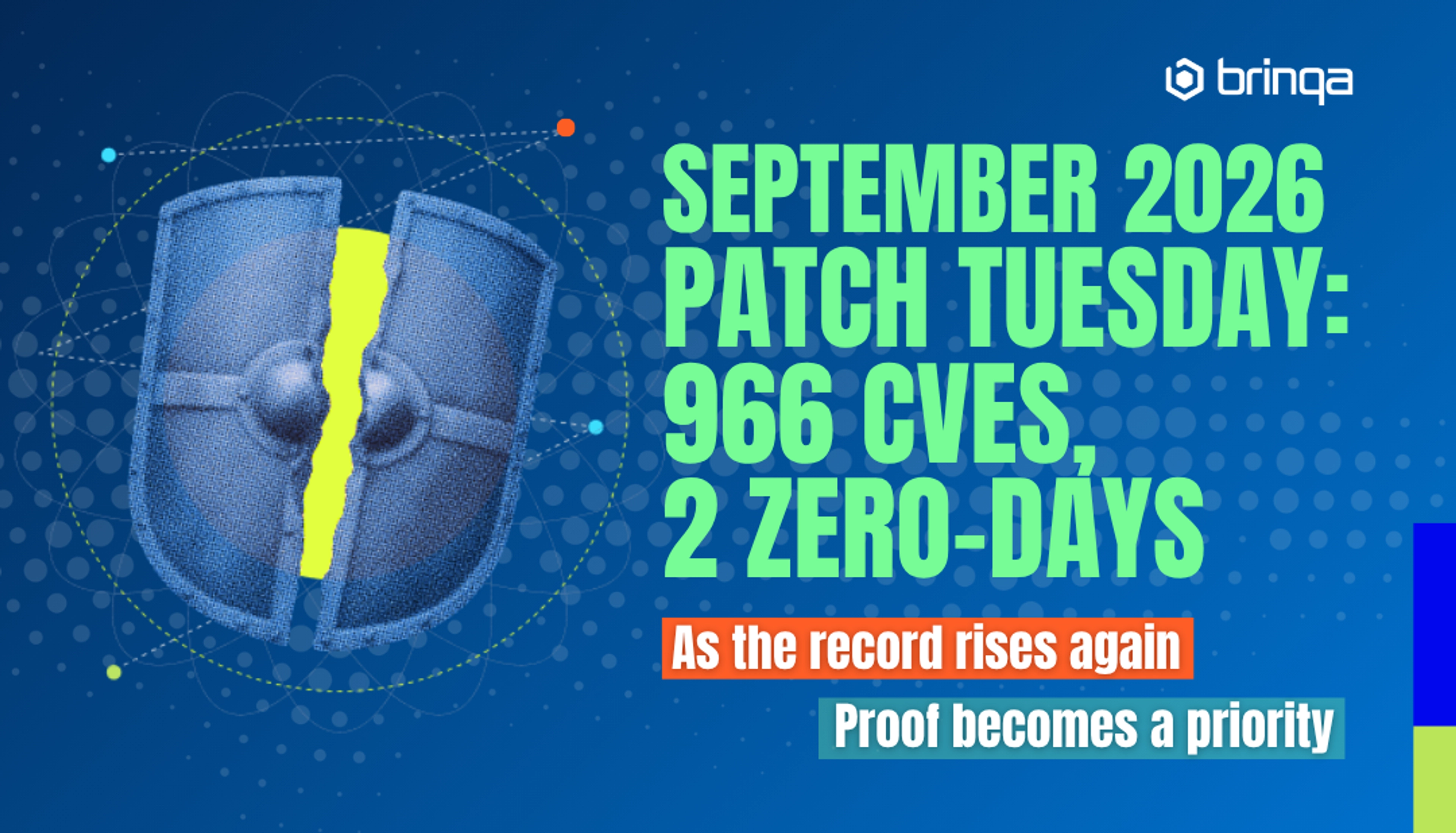
Look at Patch Tuesday. For years it was a predictable rhythm a team could plan a sprint around. AI-assisted discovery broke that rhythm. July brought 570 CVEs from Microsoft, a record at the time. August brought 400 and the industry called it quiet. September brought 966, a new record, just short of one thousand in a single release. Nine months into 2026, Microsoft alone has shipped roughly 2,700 CVEs, more than double its largest full year ever. Oracle shipped its largest update on record. Adobe went to two bulletins a month and named frontier AI as the reason. Apple jumped from 37 CVEs in June to 210 in July. And NVD has said it can no longer keep pace with enrichment.
To make things even more complex, the danger hides inside that volume. Across Microsoft’s last six releases, the flaws under attack numbered two, zero, one, two, one, and two, against totals of 167, 120, 200, 570, 400, and 966. In September, both exploited flaws were rated Important, not Critical, while 105 Criticals shipped the same day. A program that triggers on severity would have rushed 105 patches and left both real threats in the monthly queue. Knowing which two matters takes more than a score. It takes knowing whether the asset is internet-facing, whether it carries revenue, whether the flaw shows up in a known-exploited catalog, whether a control already blunts it. None of those signals live in one scanner. They only become an answer when the data is unified.
What every program needs now is a beast: an engine with an appetite matched to the volume, one that gets more useful the more you give it.
The Beast
The data will not slow down. Every finding, asset record, ownership map, and piece of business context keeps arriving, faster than any team can read it, and it never stops. Patch Tuesday is one stream. The rest of the environment produces just as much, everywhere, all the time. No team can process that by hand, and no dashboard makes it smaller.
What every program needs now is a beast: an engine with an appetite matched to the volume, one that gets more useful the more you give it. And the worst thing you can do with it is put it on a diet. Cutting the data down doesn’t improve decision making; it puts a blind spot exactly where you cut. The beast has to eat everything to enable today’s decisions to be made on today’s data.
Feed It
That is the beast we built. Brinqa’s new data engine, which fuels the enriched Brinqa CyberRisk Graph™, takes in every scanner, asset source, and piece of business context and turns them into one understandable model. It digests hundreds of millions of exposures and hundreds of millions of relationships and delivers unified, enriched, ready-to-use insight in minutes, not hours. Feed it everything.
“Brinqa gives us the confidence that our risk data is accurate and our teams are acting on what truly matters.”
– A global Fortune 500 financial services company
The flood isn’t going away, AI-assisted discovery will not get less prolific. The programs that hold up will not be the ones with the most dashboards. They will be the ones with a beast big enough for the era: fed everything, making sense of it in minutes, acting on today’s data, today.
See what the beast makes of your environment, fed everything, in minutes.
FAQs
CISOs need a unified exposure management platform that brings findings, asset ownership, business context, and threat intelligence into one model, not a dashboard that sits on top of disconnected scanners. Brinqa's data engine ingests every scanner, asset source, and piece of business context and turns it into a single enriched Brinqa CyberRisk Graph, so risk posture reflects what's actually true across the environment, not what one tool sees.
Consolidation starts with the data, not the report. When findings from every scanner and asset source feed one graph instead of a dozen disconnected tools, duplicate findings and conflicting scores disappear before they ever reach a report. This is what makes board-level reporting defensible instead of a debate about whose number is right.
An executive dashboard needs to show what to fix first and why, not raw finding counts. That requires knowing whether an asset is internet-facing, whether it carries revenue, whether the flaw is in a known-exploited catalog, and whether an existing control already blunts it. None of those signals live in one scanner; they only become an answer once the data is unified.
Resilience is measurable when the underlying data is unified and current: hundreds of millions of exposures and relationships resolved into one picture, not scattered across tools that don't talk to each other. That's what lets a security leader report on risk in minutes rather than reconciling numbers for hours before the meeting.
Board confidence comes from data confidence. As one Fortune 500 financial services customer put it: "Brinqa gives us the confidence that our risk data is accurate and our teams are acting on what truly matters." That's the standard a board-level report needs to meet: a number the room trusts.