Shortening the Exposure Window: A Full Look at Brinqa's Q4 Release
by Brad Hibbert, COO & CSO//
This year, our focus at Brinqa has been prioritization. Customers tell us they want help knowing which findings matter. They also want that guidance out of the box, based on data and analysis that is transparent and defensible, so a security leader can explain a ranking to an engineering owner, an auditor or a board.
The Q4 release is built around that. It follows three steps: understand today's true risk, focus effort on what attackers are most likely to use, and show evidence that risk came down.
The volume keeps growing
Vulnerability volume is rising across every vendor. From January 1 to October 23, 2026, more than 85,000 CVEs were published, up from about 38,000 in the same period of 2025 and already well above the 2025 full-year total of about 48,000, according to CyberHire's analysis of CVE Program data. September alone saw 14,934, more than three times September 2025.
With volume this high, organizations need to find what matters, fix what matters, and verify it was fixed. This release is built for that, and it starts with knowing which weaknesses carry real risk.
Understand your true risk
Finding what matters starts with likelihood. A severity score tells you how bad a weakness could be. It does not tell you how likely it is to be used against you. Teams lose time patching long lists while the highest risk waits. The new Exploitability Agent helps address that.
For each weakness, it judges how likely exploitation is in your environment, using threat intelligence, exploit availability and how exposed the asset is. It maps the blast radius, so you can see what would be affected. Scores adjust continuously as conditions change.
What it means for the business
- Less effort on the wrong work. Teams fix the small share of findings that carry most of the risk.
- A shorter exposure window. The weaknesses attackers are most likely to use moves to the top, so they get fixed first.
- Rankings you can defend. Every score sits in the Cyber Risk Graph with the evidence behind it.
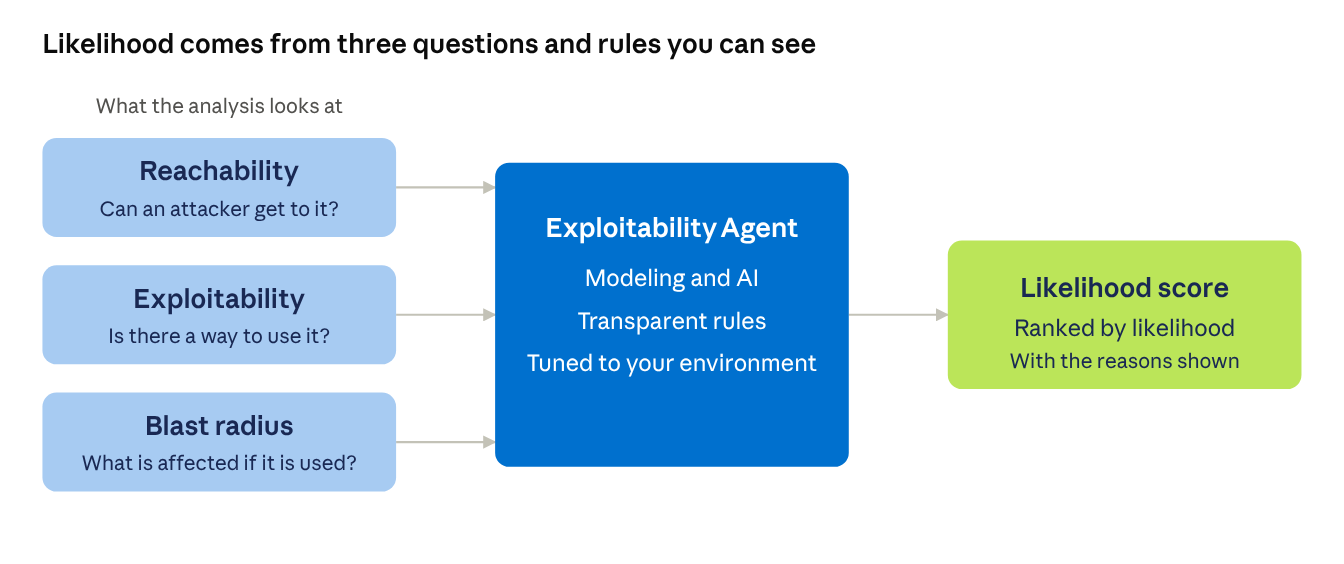
Exploitability Agent · 3 core inputs, rules and tuning, 1 score
Put your priorities to the test
A scanner tells you a weakness exists. Whether someone can use it is a separate question. The Validation Agent, arriving December 10 with introductory pricing, tests that question for you.
It is not a continuous scanner. It runs at two points in the process. During prioritization, it adds a score assessment: it plans a safe, approved test, tries common, well-known attack techniques against a finding, and uses the result to adjust the risk score before any remediation work begins. After remediation, it tries the same approaches again to check that the fix worked. It uses results from scanners, pen test findings and attack surface tools.
Every test is scoped, approved and logged. The record shows which techniques were tried, when, and what happened. Results reflect the techniques tested at that point in time, so teams can run them again as their environment changes.
What it means for the business
- Priorities backed by evidence. Findings where a test succeeded rise to the top with the details attached.
- Fewer disputes. Owners see what was tried and what happened, so the conversation starts from facts.
- A clear record for audit. Full audit details of the techniques tested, when, and the outcome, provided with the finding.
- Faster responses. Get rid of distractions and false critical vulnerabilities so every man hour is spent more efficiently.
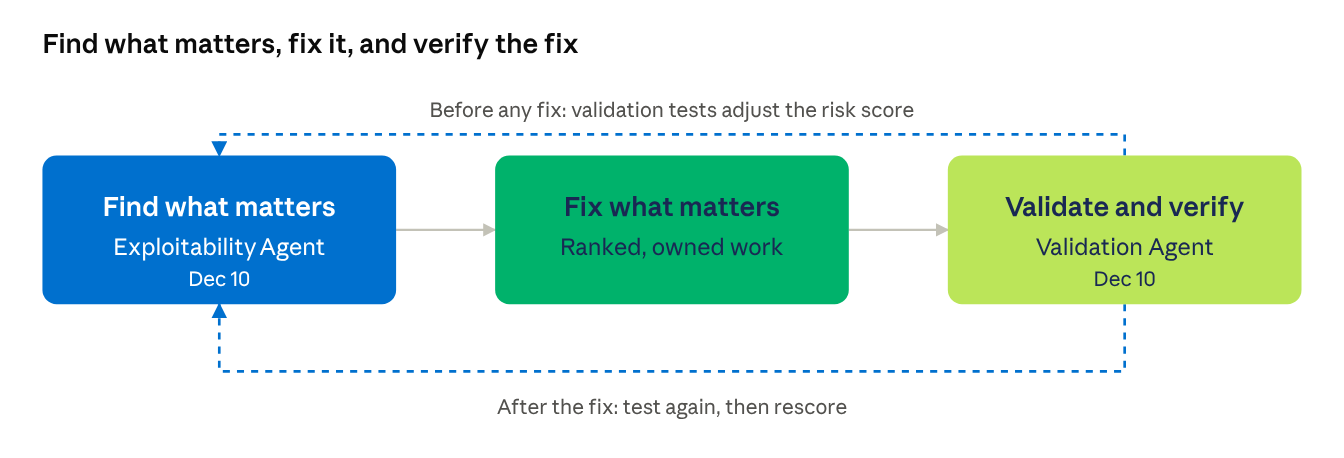
Find, fix, verify · 3 steps with a retest loop
A modernized platform that fuels better decisions
Better prioritization is only as good as the data behind it. Release 12.4 strengthens the Brinqa platform with a modernized, always-on foundation that processes ingested data more than 10X faster than previous versions. Your exposure program gets the vital data it needs, when it needs it, to drive better decisions, better actions and better business outcomes.
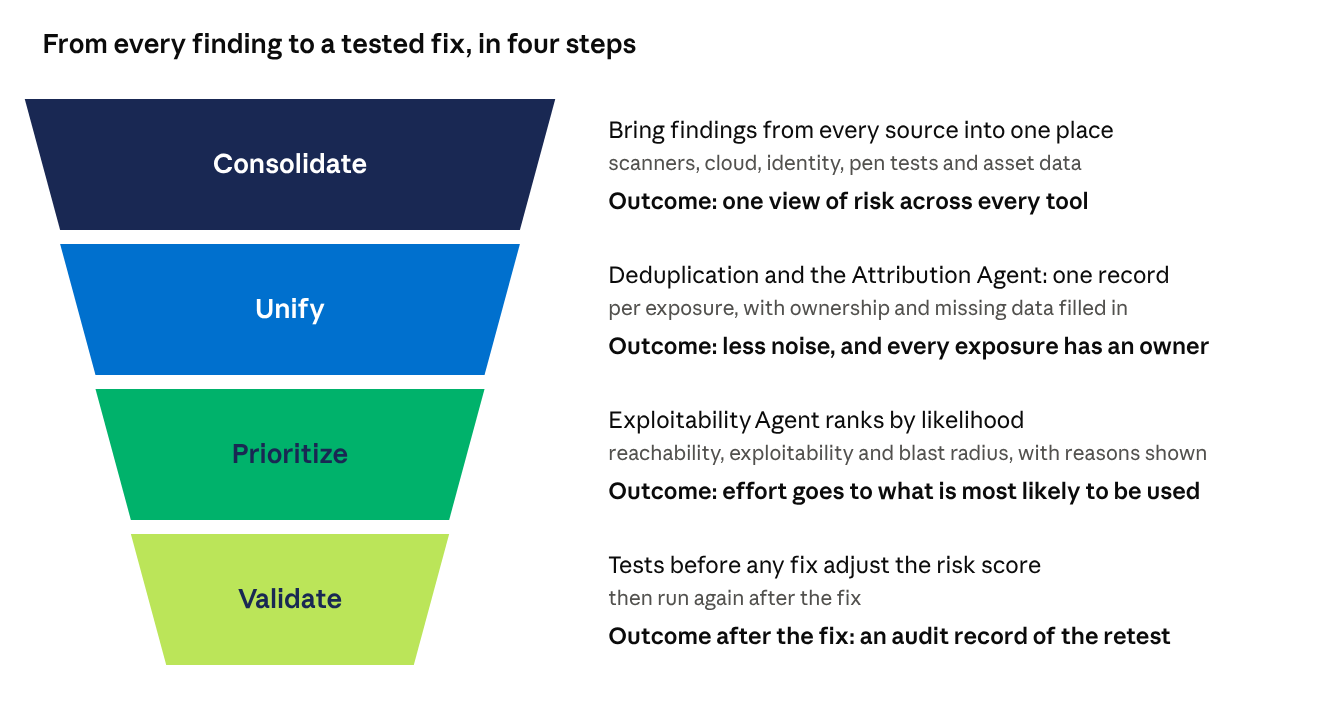
Brinqa approach · consolidate, unify, prioritize, validate
The foundation supports one approach from start to finish: bring everything together, remove the noise, rank by real likelihood, and test before and after the fix.
What’s included in this launch:
| Capability | The value to you |
|---|---|
Exploitability Agent | Fix what attackers are most likely to use, with reasons you can defend |
Modernized platform foundation | Data processed more than 10X faster, ready for larger environments |
Validation Agent | Evidence from testing common attack techniques, before and after a fix |
Next steps
If you are new to Brinqa, request a demo and we will show you how exposure is ranked in your own environment. Watch for our Validation Agent deep dive, coming soon.
FAQs
Release 12.4 adds the Exploitability Agent, the AI Validation Agent and a modernized platform foundation. Together they help security teams understand true risk, focus effort on what attackers are most likely to use, and show evidence that risk came down.
A severity score shows how bad a weakness could be. Exploitability shows how likely it is to be used against you. Brinqa’s Exploitability Agent judges that likelihood for each weakness in your environment, using threat intelligence, exploit availability and how exposed the asset is, and adjusts scores as conditions change.
Every score sits in the Brinqa CyberRisk Graph™ with the evidence behind it. That gives security leaders a ranking they can explain to an engineering owner, an auditor or a board.
The AI Validation Agent checks whether a remotely exploitable CVE can actually be exploited, whichever scanner or tester found it. During prioritization, it runs a safe, approved test using common, well-known attack techniques and uses the result to adjust the risk score. After remediation, it retests to provide evidence your fix holds.
No. Every test is scoped, approved and logged, and a person approves it before anything runs. The record shows which techniques were tried, when, and what happened, and that evidence is attached to the finding for audit.